


The operating principle of a ball screw
Publish Time:
2024-07-04
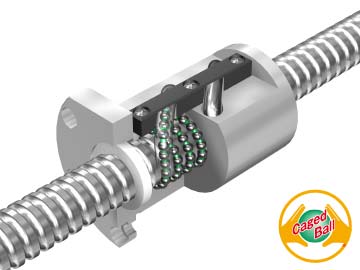
Ball Screw The working principle of a ball screw is to convert rotary motion into linear motion through the rolling of balls. When the screw rotates, the rotary motion is converted into linear motion through the rolling contact with the balls inside the nut. Simultaneously, the recirculation of the balls allows the screw to transmit power continuously and efficiently, achieving accurate and efficient linear motion.
Specifically, a ball screw mainly consists of a screw, a nut, and balls. The screw is a shaft with helical grooves, while the nut contains balls and a retainer. When the screw rotates, the balls roll in the helical grooves and, guided by the retainer, circulate within the nut. This rolling contact significantly reduces friction, thereby increasing transmission efficiency and accuracy.
In addition, ball screws have the following characteristics:
1. High precision: Due to the rolling contact of the balls, the frictional loss during transmission is minimal, thus achieving high-precision linear motion.
2. High efficiency: Due to the rolling motion of the balls, sliding friction is reduced, improving transmission efficiency.
3. Long lifespan: Due to reduced friction and wear, ball screws have a relatively long service life.
4. Reversibility: By changing the direction of rotation, bidirectional motion of the screw can be achieved.
In summary, ball screws achieve the conversion between rotary motion and linear motion through the rolling contact of balls, featuring high precision, high efficiency, long lifespan, and reversibility. They are widely used in mechanical, electronic, and aerospace fields.
Latest News

 2025-01-08

Get a Free Consultancy


No. 39, Life Second Road, Dalian Economic and Technological Development Zone, 8-5
Copyright © 2025 Maoming Precision Machinery (Dalian) Co., Ltd. All Rights Reserved.